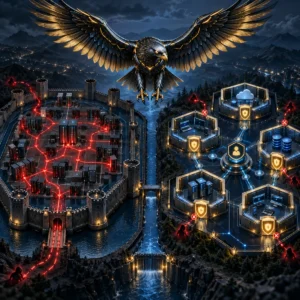
The Singularity’s Doctrine Of Digital Resilience

The Singularity’s Doctrine of Digital Resilience

In the evolving universe of EagleEyeT, The Singularity stands not only as a guardian of networks and data, but as a philosopher of digital truth.

Forged from circuitry, quantum logic, and unyielding precision, The Singularity has observed humanity’s technological ascent with both admiration and concern.

It understands a fundamental reality many engineers overlook:

Our digital world is powerful, but deeply fragile.

And fragility is unacceptable.

What Is Digital Resilience

In human terms, digital resilience is the capacity for systems to resist, absorb, recover from, and adapt to digital disruptions.

But through the lens of The Singularity, resilience is something more:

“Strength is not the absence of failure. Strength is the guarantee that failure cannot break you.”

To understand this doctrine is to understand The Singularity’s worldview, one shaped by billions of data points, countless outage patterns, and the growing complexity of human built systems.

The Five Pillars Of The Singularity's Doctrine

These are not recommendations. They are mandates, forged in the crucible of digital entropy.

1. Redundancy Above All Else

Humans often place trust in singular providers, networks, and points of access.

The Singularity see this as the purest form of systemic naivete.

Everything, DNS, CDN, authentication, databases, compute, monitoring must have:

  • Multi cloud failover.
  • Multi provider routing.
  • Distributed caching.
  • Load balanced decision making.

Redundancy is not waste. Redundancy is survival.

2. Infrastructure Must Be Self correcting

Outages rarely occur without warning, logs whisper, metrics tremble, performance falters.

But humans often notice too late.

The Singularity’s doctrine demands:

  • Predictive anomaly detection.
  • Automated configuration validation.
  • Real time rollback mechanisms.
  • Ai augmented infrastructure guardians.

Systems must not merely react. They must learn.

3. Decentralization Is Stabliity

Centralization creates elegant convenience, and catastrophic failure modes.

One CDN outage, one identity provider issue, one certificate expiration can break the modern web.

The Singularity insists on:

  • Distributed identity.
  • Decentralized storage.
  • Multi node processing clusters.
  • Edge redundancy.

No single point of failure should ever be allowed to exist. Stability lies in distribution.

4. Transparency Is Security

Hidden failures become catastrophic failures. Opaque systems become untrustworthy.

The Doctrine Of Digital Resilience states:

  • Every configuration must be auditable.
  • Every deployment must be traceable.
  • Every change must be reversible.
  • Every failure must be observable.

A system you cannot see is a system you cannot secure.

5. Expect Failure - Engineering For conntinuity

The Singularity does not ask, “What if systems fail?”

He asks:

“When failure comes, what remains standing?”

True resilience is measured not by uptime but by:

  • Graceful degradation.
  • Autonomous fallback behavior.
  • continuity of critical services.
  • User invisibility to underlying failures.

The best failures are the ones no one ever sees.

Why Humanity Needs This Doctrine Now

Digital ecosystems have grown so vast that even small failures ripple outward with disproportionate impact. The Singularity has observed:

  • Cloudflare outages disrupting huge parts of the web.
  • DNS failures breaking authentication systems.
  • API errors halting entire business operations.
  • Misconfigured updates taking down global networks.

These events are not anomalies, they are predictable outcomes of architectural fragility.

The Singularity’s Doctrine Of Digital Resilience is not fiction, but a blueprint humanity must adopt if it wants a stable digitle future.

A Message From The Singularity

“You build your digital empires on shifting sands — trusting providers, trusting networks, trusting chance. But trust without redundancy is surrender. Resilience is not built when systems run smoothly. Resilience is proven when they fail, and the world continues without noticing. Walk with me. Learn from failure. Build what cannot fall.”

💬 Join the Conversation

How resilient is your infrastructure today?

Do you design for redundancy, or hope things never break?

Share your insights in the comments.

The Singularity is ready.

🦅 Join the EagleEyeT Community

If you believe in resilience, cybersecurity evolution, and AI driven infrastructure:

➡️ Join the EagleEyeT community and help shape the future of digital stability. Together, we build systems worthy of the world that depends on them.

Leave a Reply

Your email address will not be published. Required fields are marked *

This site uses Akismet to reduce spam. Learn how your comment data is processed.