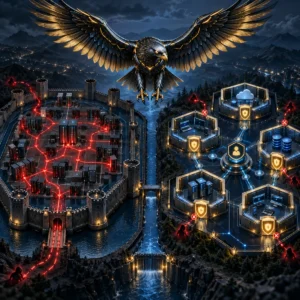
The Incident Command Framework – Why effective incident response requires leadership, not just tooling

incident command framework

Security incidents no longer unfold neatly, but sprawl across identity platforms, cloud infrastructure, endpoints, SaaS applications, legal obligations and executive decision making often at the same time.

The Singularity observes a recurring failure pattern:

Organisations invest heavily in detection, but almost nothing in decision structure.

An Incident Command Framework exists to solve that problem. It transforms incident response from ad hoc reaction into a coordinated command and control.

What Is an Incident command Framework?

An Incident Command Framework is a structured approach to managing security incidents that defines:

  • Clear leadership and authority.
  • Decision making ownership.
  • Communication flows.
  • Operational coordination.
  • Business and legal integration.

IT borrows principles from emergency management and military command modules, adapted for cybersecurity and enterprise environments.

The goal is simple: One incident, one commander, one coordinated response.

Why Traditional Incident Response Models Fail

Tool Drive Response

Many organizations rely on:

  • SIEM alerts.
  • EDR workflows.
  • SOAR playbooks.
  • Case management systems.

These tools are valuable, but they do not:

  • Weigh business risk.
  • Resolve conflicting priorities.
  • Decide when to shutdown systems.
  • Coordinate legal and executive actions.

Tools generate data, and command generates decisions.

Fragmented Authority

In many incidents:

  • Security investigates.
  • IT remediates.
  • Legal reviews.
  • Communications reacts.
  • Executives are briefed late.

This creates:

  • Conflicting actions.
  • Delays.
  • Inconsistent messaging.
  • Increased regulatory and reputational risk.

The Singularity notes that distributed authority during a crisis is a liability.

Core Roles In An Incident Command Framework

Incident Commander

The Incident Commander (IC) is the single authority responsible for:

  • Overall situational awareness.
  • Prioritization of actions.
  • Decision approval.
  • Escalation management.
  • Executive alignment.

The IC does not need to be the most technical person, but must have:

  • Authority.
  • Trust.
  • Decision clarity.
  • Calm under pressure.

Operations

Responsible For:

  • Containement actions.
  • Technical remediation.
  • Forensics and evidence handling.
  • Execution of approved tasks.

Operations execute, they do not decide the strategy.

Intelligence & Analysis

Focused on:

  • Understanding attacker behavior.
  • Tracking scope and blast radius.
  • Correlating signals across systems.
  • Anticipating next attacker moves.

The Singularity values analysis over alert volume.

Communications & Liason

Handles:

  • Internal updates.
  • Executive briefings.
  • Legal coordination.
  • External communications if required.

Silence and misinformation both increase damage.

Command Over Speed

A common mistake during incidents is prioritizing speed over control.

Rushing containment without:

  • Understanding scope.
  • Preserving evidence.
  • Aligning stakeholders.

This often results in:

  • Missed persistence.
  • Regulatory exposure.
  • Repeated compromise.

The Incident Command Framework enforces deliberate action.

Slow is smooth, and smooth is fast.

Incident command As A Governance Control

Incident Command is not just operational, it is governance.

It ensures:

  • Decisions are auditable.
  • Actions are authorized.
  • Communications are consistent.
  • Legal exposure is managed.
  • Executie accountability is maintained.

From The Singulatiry’s perspective:

An incident response without governance is itself a risk.

Practicing The Framework Before It's Needed

Incident Command cannot be improvised.

Effective organizations:

  • Run tabletop exercises.
  • Simulate multi domain incidents.
  • Practice executive decision making.
  • Validate authority chains.
  • Stress test communications.

These exercises reveal:

  • Hidden assumptions.
  • Authority gaps.
  • Tool limitations.
  • Cultural weaknesses.

Preperation reduces panic.

Integrating Incident Command With Zero Trust

Zero Trust assumes breach, and Incident Command assumes impact.

Together they form a complete posture:

  • Zero Trust limits blast radius.
  • Incident Command manages consequence.
  • Monitoring feeds command decisions.
  • Governance ensures resilience.

Security is not prevention alone, it is control under pressure.

The Singularity's Incident Command Principles

The Singularity enforces five non negotiable principles:

  1. One incident, one commander.
  2. Authority defined before crisis.
  3. Behavior over alerts.
  4. Communication as a control.
  5. Governance over heroics.

Systems survive breaches, but organizations survive leadership.

Final Thoughts: Command Is The Missing Layer

Most organizations prepare for:

  • Detection.
  • Containment.
  • Recovery.

Few prepare for:

  • Decision paralysis.
  • Conflicting authority.
  • Executive pressure.
  • Legal scrutiny mid incident.

The Incident Command Framework fills that gap.

The Singularity does not react to incidents, it commands them.

Call To Action

If your organization has not:

  • Defined an Incident Commander (IC role.
  • Practiced executive level incident decisions.
  • Integrated legal and communications into IR.
  • Tested response beyond technical teams.

Then your incident response is incomplete.

Leave your thoughts and comments down below and follow EagleEyeT for enterprise grade security thinking where leadership, architecture, and resilience come before tools.

Remember The Singularity is always watching.

Leave a Reply

Your email address will not be published. Required fields are marked *

This site uses Akismet to reduce spam. Learn how your comment data is processed.