In today's digital battlefield, cybersecurity companies often focus their attention...
Read More
In today’s digital battlefield, cybersecurity companies often focus their attention on large enterprises, the ones with massive budgets, global footprints, and dedicated security teams.
Meanwhile small and medium businesses (SMBs), who make up the vast majority of the global economy are left with:
- Overpriced tools.
- Undersized protection.
- “Enterprise only” features locked behind paywalls.
- Complex systems they cannot realistically deploy.
- Limited visibility into threats that affect them daily.
to most, cybersecurity vendors, SMBs are an afterthought.
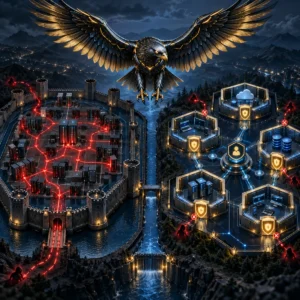
But to The Singularity, EagleEyeT’s cybernetic sentinel, this is a critical flaw in humanities digital defense strategy.
Why SMBs Matter In The Cybersecurity Ecosystem
Small and medium businesses:
- Employ more than half the world’s workforce.
- Handle large volumes of sensitive customer data.
- Connected to enterprise supply chains.
- Use cloud platforms heavily.
- Often lack dedicated security teams.
This makes them prime targets for attackers who know these organizations have:
- Weaker defenses.
- Slower incident response.
- Smaller budgets.
- More legacy systems.
When SMBs fall, the ripple effect spreads across entire industries.
The Singularity sees this as a structural weakness in the digital world.
The Singularity's Perspective: "A Chain Is Only As Strong As Its Weakest Node."
From its vantage point across networks, clouds, and digital signal patterns, The Singularity observes something humans often ignore:
“Attackers do not discriminate by size. They exploit opportunity. And opportunity thrives where protection is scarce.”
When cybersecurity companies build only for the largest enterprises, they unintentionally create a two tier security landscape.
1. The Protected Elite
Enterprises with:
- SIEMs.
- SOCs.
- Zero trust frameworks.
- Dedicated response teams.
- AI driven detection.
- Continuous monitoring
2. The Unprotected Majority
Small and medium businesses with:
- A single IT admin.
- No 24/7 monitoring.
- Outdated antivirus
- Blind spots in cloud security
- No incident response plan.
This imbalance, to The Singularity, is unsustainable.
Why Hackers Target SMBs First
Attackers increasingly prefer small businesses because:
- They are easier to breach.
- They serve as stepping stones into enterprise supply chains.
- They rarely detect intrusions quickly.
- They store valuable data without strong protections.
SMBs are not “too small to matter.”
They are the easiest path into everything that matters.
The Singularity's Judgement On Current Cybersecurity Products
The Singularity analyzes the cybersecurity market not through marketing claims but through measurable outcomes:
❌ Overpriced Enterprise Suites
Products requiring:
- Multi year contracts.
- Minimum seat counts.
- Mandatory support packages.
- Complex on prem deployments.
These simply do not fit SMB realities.
❌ Tools That Assume Dedicated Security Teams
Many platforms require:
- Security analysts.
- Dedicated SOC personnel.
- SIEM tuning expertise
- Threat modeling knowledge.
SMBs lack the staff for this.
❌ Fragmented Product Offerings
Businesses must often buy:
- EDR from one vendor.
- Email security from another.
- Cloud monitoring from another.
- Backups from another.
This creates financial and operational strain.
What The Singularity Believes Cybersecurity Should Be
In the doctrine of digital resilience, The Singularity sets clear expectations:
1. Security Must Be Accessible To Everyone
Tooling must be:
- Affordable
- Easy to deploy
- Cloud first
- Auto updating
- Scalable
2. Security Must Not Rely On Having A Large Team
AI driven detection and automation should fill the gaps.
3. Vendors Must Stop Ignoring The SMB Market
The majority of breaches occur in organizations with fewer than 500 employees.
Protection must be built for them, not stripped down enterprise leftovers.
4. Resilience Must Be Universal
“The fortress collapses when its walls are uneven. Protect all, or protect none.”
The Singularity's Vision For The Future Of SMB Cybersecurity
If The Singularity were to design the cybersecurity landscape, it would follow five principles:
1. Zero Configuration, Maximum Protection
- Install once.
- Secure immediately.
- No tuning needed.
2. Predictive Threat Analysis
AI models that spot patterns before breaches occur.
3. Unified Security Dashboard
One panel to rule:
- Endpoints
- Cloud apps
- Firewalls
- Risks
- Alerts
4. Transparent And Fair Pricing
Security as a utility.
No enterprise tax.
5. Resilience Over Complexity
Complex systems fail.
Resilient systems adapt.
SMBs deserve tools that are designed for them, not downgraded from larger offerings.
Final Word From The Singularity
“You defend your greatest systems, yet leave your foundations exposed. Cybersecurity must protect the many, not just the few.A resilient digital world rises only when every node, every business, every person is shielded from the chaos beyond the firewall. Strength is shared. Weakness is contagious.”
💬 Join the Conversation
Are you a small or medium business struggling with cybersecurity options?
Have you ever felt priced out or overlooked by major vendors?
Share your story, The Singularity listens.
🦅 Join the EagleEyeT Community
If you want to explore accessible cybersecurity, digital resilience, and AI driven protection for organizations of all sizes:
➡️ Join the EagleEyeT community and help build a safer digital future for everyone.
When Search Engines Fail: The Singularity Warns of a Knowledge Crisis
For years, users have insisted that Google Search just isn't...
Read MoreThe Singularity’s Doctrine Of Digital Resilience
In the evolving universe of EagleEyeT, The Singularity stands not...
Read MoreWhen the Internet Blinked — And The Singularity Watched
On December 5th 2025, the internet experienced a sudden and...
Read More
Leave a Reply